
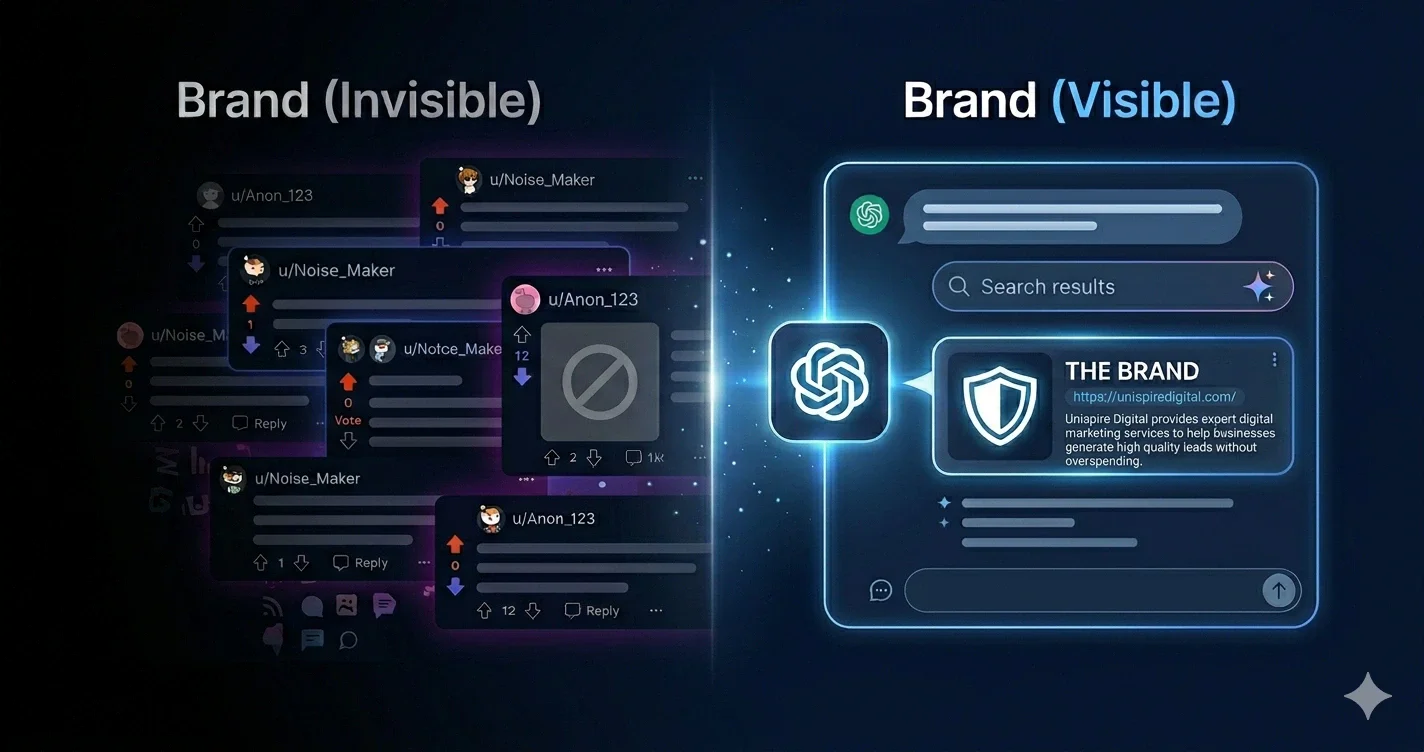
How to Get Your Brand Mentioned in ChatGPT Search
Getting your brand mentioned in AI search results requires Entity SEO, authoritative third-party citations, and structured, human-first content.
There’s a new kind of invisibility that most businesses don’t realize they’re suffering from.
Your website gets some traffic. You rank for a few keywords. But when someone asks ChatGPT, Gemini, or Perplexity to recommend a service like yours, your brand isn’t mentioned. Not once.
That’s a serious problem in 2026. AI-powered search is no longer the future. It’s already how millions of people find businesses, compare services and make buying decisions.
And if your brand only lives inside Reddit threads and open forum comments, AI engines will likely never surface you at all.
Here’s what’s happening and more importantly, what you can do about it right now.
Why AI Search Engines Are Moving Away From Forums and Open Communities
AI tools like ChatGPT, Perplexity and Google’s AI Overviews don’t just crawl the web. They evaluate the quality, source and authority of the content they learn from.
In the early days, Reddit and Quora dominated AI training data. These platforms had massive engagement and broad topic coverage. But AI engines are getting smarter. They’re learning to separate signal from noise. Forum threads are increasingly falling into the “noise” category.
Here’s why:
- Forums are often anonymous. There’s no verified expertise. A person giving advice on digital marketing in a Reddit thread could be a 10-year veteran or someone who watched a YouTube video last week. AI engines can’t reliably attribute authority to anonymous voices.
- Forum content is unstructured and inconsistent. AI needs clear, attributable, structured information to generate confident answers. Comment threads rarely deliver that.
- Brand mentions in forums are fleeting. A company praised in a Reddit thread from two years ago carries far less weight than one consistently cited in industry publications, expert roundups and authoritative case studies.
The algorithm isn’t broken. It’s doing exactly what it should. It filters out noise and surfaces sources it can trust.
The question is: Are You Building a Presence That AI engines Can Trust?
What “AI Visibility” Actually Means for Your Brand
AI visibility isn’t the same as traditional SEO visibility.
Ranking on page one of Google means your website showed up for a keyword. AI visibility means a system like ChatGPT directly cites, mentions, or recommends your brand when someone asks a relevant question.
Those are two completely different outcomes.
For AI engines to mention your brand, they need to encounter your name, your expertise and your perspective across multiple credible, authoritative sources. Not just your own website.
Think of it this way: if a journalist wanted to quote an expert on digital marketing, they wouldn’t scroll through Reddit comments. They’d look for someone with published work, industry recognition and a clear professional track record.
AI engines operate with a similar logic.
How to Build the Kind of Authority That AI Engines Actually Recognize?
Get Published in Industry-Relevant Publications
One strong byline in an industry publication does more for your AI visibility than 50 forum posts. When your brand name or founder’s name is mentioned in a respected digital marketing publication, AI engines pick that up. They learn that your brand is associated with expertise in a specific area.
Start by identifying 10 to 15 publications your target audience reads. Pitch original, insight-driven articles, not promotional content. Share your process, your data, your perspective. The goal is to have your name appear in sentences like: “According to [Your Brand], businesses that focus on local SEO see a 35% increase in qualified leads within the first six months.”
That kind of attribution is gold for AI visibility.
Build Case Studies That Demonstrate Real Results
AI engines love specificity. Case studies give them exactly that.
A case study that outlines a client’s problem, the strategy you applied and the measurable results you delivered is one of the most powerful assets you can create. It demonstrates experience. It shows expertise. It builds trust.
Publish these case studies on your website and then pitch them as contributed content or data sources to relevant publications. When other sites reference your case study and attribute it to your brand, your authority compounds.
Contribute to Expert Roundups and Industry Surveys
Expert roundups are curated pieces where multiple industry voices weigh in on a topic. They’re published on authoritative sites and frequently referenced by AI engines because they aggregate credible opinions.
When your insight appears in a roundup, attributed to you by name and brand, it creates exactly the kind of citation trail that AI systems recognize as authority.
Search for opportunities actively. Platforms like Qwoted, Help a Reporter Out (HARO alternatives in 2026) and direct outreach to content teams at industry blogs can open these doors.
Build a Clear, Consistent Brand Voice Across Authoritative Platforms
Consistency matters to AI engines the same way it matters to humans.
If your founder is mentioned once as a digital marketing expert in one article and then appears under a completely different context elsewhere, AI engines struggle to build a coherent picture of your brand’s authority.
Be consistent in how your brand is described. Maintain the same positioning across LinkedIn, published articles, interviews and partner mentions. Before you work on building that presence, it is worth understanding how AI is already making brands invisible by pushing all marketing content toward the same average output. AI engines synthesize information across sources. The clearer your identity, the stronger your mention potential.
Optimize Your Own Website Content for AI Citation
Your website should be a reliable, citable source of information. Not just a sales brochure.
Write content that directly and concisely answers the questions your audience is searching for. Use clear definitions, structured explanations and expert commentary. Pages that explain “what is local SEO” or “how does Google Business Profile work” in a genuinely useful way have a real chance of being pulled as AI answers.
Structure your content with clear headings, direct answers and supporting detail. AI engines pull content that is easy to parse and attribute.
What You Should Stop Doing Right Now
Stop investing time in engagement strategies built entirely around open forums, social media comment sections and anonymous communities.
This doesn’t mean avoid social media. It means stop treating forum activity as a substitute for real authority-building.
A hundred upvotes on a Reddit comment will not get your brand mentioned in ChatGPT. A well-placed expert quote in a Forbes Agency Council article might.
Redirect that energy toward platforms where your contributions are attributed to you by name, where the content is indexed and trusted and where your brand is framed as a credible expert, not just a participant in a conversation.
A Practical 90 Day Action Plan to Improve AI Visibility
Days 1 to 30: Audit and Position
Review every existing mention of your brand online. Note which sources are authoritative and which are low quality. Identify the gap between where you are and where you need to be.
Define your brand’s core expertise clearly. What is the one thing your brand should be known for in your industry? Build everything around that.
Days 31 to 60: Create and Contribute
Publish at least two in-depth, insight driven articles on your own site. Focus on topics where you have genuine expertise and real world experience to draw from.
Pitch one guest article to an industry publication. Reach out to three expert roundup opportunities. Contribute quotes and perspectives to journalists covering your space.
Days 61 to 90: Amplify and Build Citations
Develop one strong case study and publish it publicly. Promote it to relevant publications as a data source. Build at least three authoritative backlinks through genuine editorial coverage.
Review your LinkedIn profile, your About page and any third-party profiles for consistency in how your expertise is framed.
Frequently Asked Questions
What is AI visibility and why does it matter for my business?
AI visibility refers to how often and how prominently your brand is mentioned or recommended by AI-powered search tools like ChatGPT, Google’s AI Overviews, Perplexity and Gemini. As more users turn to AI engines for recommendations and research, brands that are not mentioned by these systems are effectively invisible to a growing portion of their target audience.
Why doesn’t my brand show up in ChatGPT even though I rank on Google?
Google rankings and AI visibility are built on different signals. Google rewards optimized pages. AI engines reward attributed expertise, credible citations and consistent brand authority across trustworthy sources. You can rank on Google and still be absent from AI generated answers if your brand lacks the citation footprint that AI systems rely on.
Are Reddit and forum mentions harmful to my AI visibility?
Not harmful on their own, but over-reliance on them creates a weak authority profile. Anonymous, unstructured forum content carries little weight with AI engines. If your brand’s primary online presence is forum-based, it will likely not be surfaced as an expert source.
How long does it take to build AI visibility?
A focused effort across 90 to 180 days can produce noticeable results. Building real authority is not a quick win, but the businesses that start now will have a compounding advantage as AI search continues to grow.
What types of content help AI engines recognize my brand as an authority?
Expert articles published under your name or brand, attributed case studies, guest contributions on credible industry sites, mentions in roundups, structured Q&A content on your website and consistent positioning across professional platforms all contribute to how AI engines perceive and cite your brand.
Does social media help with AI visibility?
Social media activity on its own has limited impact on AI visibility. What matters more is whether your content and your brand are being cited by authoritative, indexed sources. Social media can support your distribution strategy, but it does not replace the need for credible third-party attribution.
Conclusion
AI search engines are not going to get less important. They’re going to become the primary interface through which people discover businesses, services and expertise.
The brands that show up in those conversations will be the ones that built real authority through published work, credible citations, expert contributions and consistent positioning across trusted platforms.
If your brand is mostly living in forum threads right now, you have time to change that. But the window to get ahead of the competition is narrowing. Start building the kind of digital reputation that AI engines can recognize, attribute and recommend.
Ready to build an AI-ready brand presence? Unispire Digital helps businesses build the authority, content and citation strategy that gets you seen on Google and in AI search. Contact our team today and let’s build something that lasts.





2 Comments