
The AI Trap Making Your Brand Invisible in 2026
Most marketers believe AI is their creative advantage. New data suggests it might be quietly erasing the one thing that makes their brand worth remembering.
There is a trap embedded in the way most marketing teams are using AI right now and it is not the one most people are talking about. The conversation tends to focus on authenticity, on whether consumers can tell the difference between human and machine writing. But that misses the deeper problem. The real danger is not that AI content feels fake. It is that AI content feels familiar. When every brand uses the same tools, feeds them the same prompts, and publishes the output without a second thought, the result is not bad marketing. It is average marketing. And in a noisy, attention-scarce world, average is functionally invisible.
Campaigns analyzed across dozens of brands reveal a striking pattern: the companies leaning hardest into AI-generated content are producing more, but audiences remember them less. Meanwhile, brands that avoided AI entirely were falling behind on volume and consistency. Then there is a third group, a small but measurably outperforming cohort, who found a different way. Understanding what separates them is the most important marketing question of this moment.
AI is Making Marketing Average by Design
The capabilities AI has unlocked are worth paying attention to. A single marketer today can produce ad visuals, scripts, voiceovers and animations that would have required entire creative departments and seven-figure production budgets a decade ago. The technology has been a real shift in what small teams can do, and no serious practitioner would argue otherwise. For businesses looking to stay ahead of these shifts, working with a digital marketing agency that understands both AI tools and brand identity is what separates growth from stagnation.
But there is a structural problem built into how these tools work by design, one the marketing industry has been slow to talk about. Generative AI does not create originality. It generates the statistical average of everything its developers trained it on. Scroll through LinkedIn and social media feeds on any weekday and this dynamic becomes hard to ignore. The same hook structures, the same listicle formats, the same aspirational framing, reproduced across hundreds of brands with minor variation. The content is technically competent. It is also deeply interchangeable.
“AI doesn’t create originality. It creates a statistical average of the internet: the most probable next word, the most expected idea, the least surprising take.”
Your audience may not be able to articulate why something feels off, but they scroll past it anyway. Nobody receives the signal, because there is no signal. Just noise dressed up as content.
54% of long-form LinkedIn posts are now AI generated, a 189% increase since ChatGPT’s public launch. 45% less engagement earned by AI generated posts compared to original human-authored content on the same platform.
“If your AI workflow begins with “generate content,” you have already narrowed your creative ceiling before the work has started. The starting point determines the quality ceiling of the output.”
Your Brand is a Feeling, Not a Logo
One of the most persistent misconceptions in marketing is that a brand is primarily a visual identity: a logo, a color palette, a tone-of-voice document filed somewhere on a shared drive. These elements matter, but they are not what a brand actually is. A brand is the reaction people have when they encounter your company. It lives not in a design system, but in the feeling your work triggers the moment someone sees it.
Think about what Levi’s represents: classic American durability, something timeless and unpretentious. Or consider what Dove has built over decades, a consistent, coherent idea about real beauty that runs through every touchpoint, every campaign, every product decision. These brands do not just produce content. They produce a recognizable emotional signal that their audiences have learned to associate with something specific and meaningful.
When companies rely too heavily on AI generated marketing, that signal disappears. Everything becomes polished. Everything becomes competent. And somehow everything becomes interchangeable. Polished and soulless are not opposites. They coexist, and in AI heavy content, they frequently do.
“A brand doesn’t live inside a design system or a brand book. It lives in the reaction people have when they encounter your company.”
Coca-Cola’s attempt to remake its iconic Christmas advertisement using AI offers the clearest case study on record. The original campaign had spent decades building genuine emotional equity. The AI generated remake was technically accomplished. Critics widely described it as soulless. One independent analyst scored it just 22 out of 100.
A marketing professor observed that the backlash hit so hard precisely because Christmas advertising is supposed to embody connection and community, values that AI production methods fundamentally undercut for that audience. The brand that practically invented emotional advertising could not replicate the feeling with AI. That is not a technology failure. That is a taste failure. If your brand faces a similar challenge, the quality of your content strategy and writing is often where brand identity either holds or dissolves.
Use AI to Expand Ideas, Not Replace Them
The companies outperforming their peers are not avoiding AI. They have simply discovered a completely different way to deploy it. The shift is small but it changes everything: they use AI earlier in the creative process, not later. And that changes what the output looks like.
In traditional advertising agencies, creative teams never jumped straight from brief to execution. They started in open territory, tossing around half-formed ideas, making unexpected cultural connections, following tangents that sometimes led nowhere and occasionally produced the best idea in the room. The strongest campaigns frequently emerged from an offhand comment, a random association, a perspective that came from outside the core team.
AI can play that role in the early stages of creative development, not as a finisher, but as an explorer. Instead of asking AI to write the ad, use it to map the territory around the brand: adjacent themes, unexpected metaphors, emotional states you want to evoke, cultural references worth considering. This is the difference between creative convergence and creative divergence.
In one documented example, a creative team exploring loose conceptual territory around a brand surfaced the word “flow” during an AI-assisted brainstorm. That single word became the seed for the entire campaign direction. It was not the AI’s idea. It was the AI surfacing something the human team recognized as meaningful. That recognition is the work AI cannot replace.
“The best marketers do not treat AI as a writer. They use it as an idea accelerator, the tool that helps them see more possibilities before committing to the strongest one.”
Build a Creative System, Not a Prompt
The smartest teams have moved beyond thinking of AI as a single tool you open and type into. They are building systems: layered, interconnected, and built around the specific needs of their brand. As Google’s agentic commerce tools in 2026 continue to reshape how brands interact with customers across AI-driven touchpoints, the brands building internal creative systems are the ones best positioned to stay distinctive across every channel.
In practice, these systems distribute different cognitive tasks across specialized AI tools. One system might analyze contextual trends and surface opportunities the brand could authentically respond to. Another evaluates whether a creative concept actually fits within the brand’s established voice and values. Teams use a third purely to explore directions before committing to any of them.
In this architecture, AI is not replacing the creative team. It is expanding the team’s bandwidth, giving people the ability to evaluate more possibilities in less time and arrive at stronger ideas faster.
That matters a lot: the marketers who will win with AI over the next five years will not be those who write the cleverest prompts. They will be those who design the best systems: processes and toolchains that help their teams discover better ideas, evaluate them more rigorously, and execute on the strongest ones without losing the brand’s identity in translation.
The Real Competitive Advantage is Human Taste
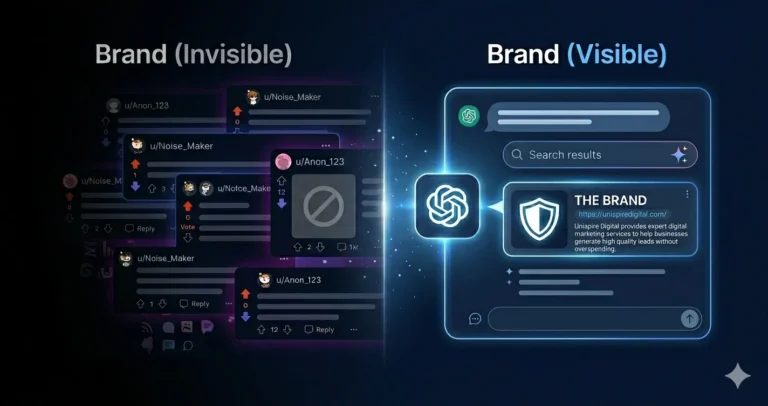
There is a structural shift underway in the economics of marketing that most practitioners have not caught up with yet. As AI continues to improve, the cost of execution is dropping toward zero. This extends beyond content generation. It now includes how brands appear in AI search results. Understanding how to get your brand mentioned in ChatGPT and AI search is becoming as important as the content itself, because visibility in generative AI outputs depends on the same brand trust signals that humans respond to.
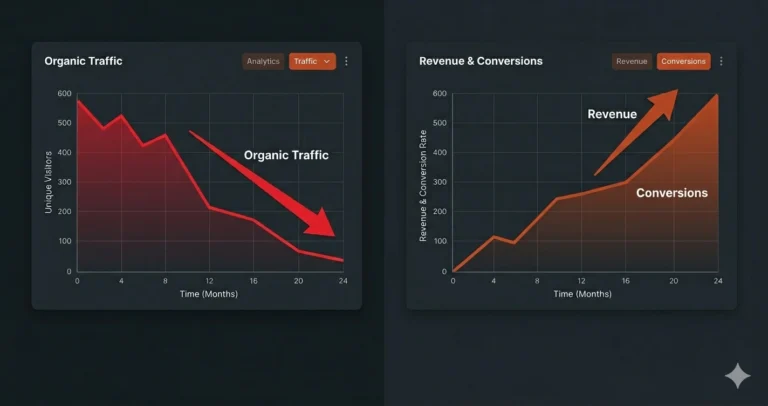
The research bears this out. Human-generated content currently receives over five times more traffic than AI generated content, and that gap shows consistent growth over time. But here is the key detail. The highest performing companies are not the ones avoiding AI. They are the ones who have developed clarity about where AI should contribute and where humans must lead.
5× more traffic earned by human generated content compared to AI generated content in 2025-2026 studies. 22/100 score given to Coca-Cola’s AI Christmas ad remake by independent analysts.
AI can generate a wall of possibilities. But nobody can automate the ability to look at that wall and say, with full confidence: that one, that is the one. Marketers call that capacity taste. It is the accumulated product of cultural immersion, lived experience, deep brand knowledge, and an accurate understanding of what an audience actually feels versus what marketers think they feel.
“In the AI era, the skill that matters most is not prompting. It is taste. The ability to recognize the idea worth building a campaign around. Nobody can automate that.”
The future of marketing will not be AI versus humans. It will be creative teams using AI to explore more territory, test more directions, and move faster, while the final decisions come from people who understand culture, context, and the brand they are actually building. Brands that combine both will move faster than everyone around them without becoming average. That is the third way. And it starts with ensuring your SEO and visibility foundations are strong enough to support the distinctive content your brand produces.
What To Do with This?
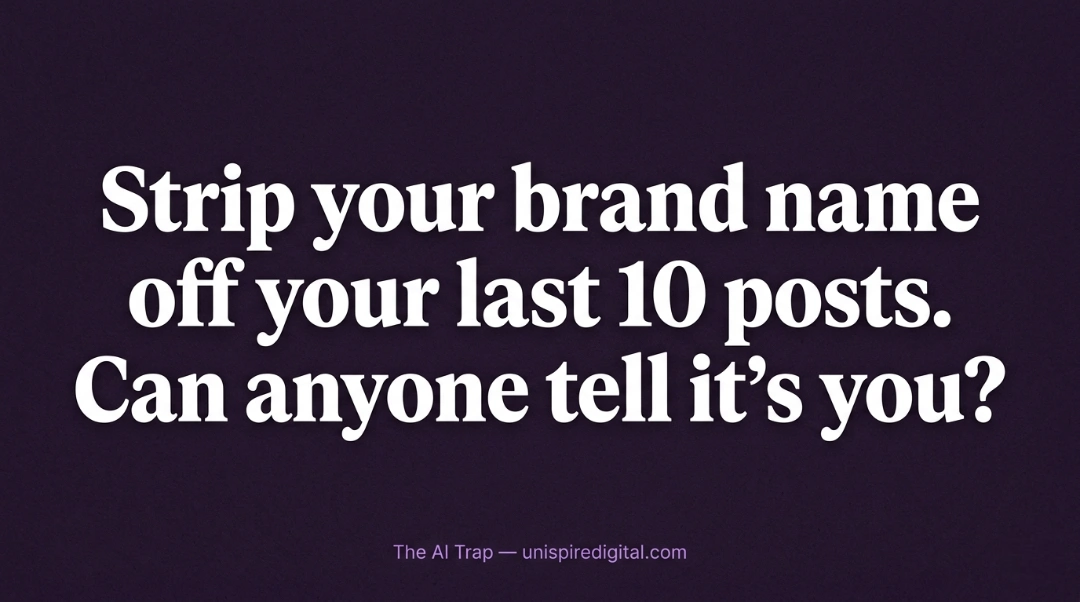
- Take your last ten pieces of content, strip the brand name off, and show them to a colleague. Ask: “Can you tell this is us?” If they cannot, you are already in the trap.
- Move AI earlier in your creative process. Use it to explore territory, not to write final copy. Diverge before you converge.
- Stop prompting and start designing systems. Build layered AI tools that play specific roles rather than relying on one generic tool for everything.
- Invest deliberately in developing taste on your team. Hire for cultural awareness, not just execution speed. The judgment call is the job.
- Protect your emotional signal. Every piece of content should produce a specific, recognizable feeling. If you cannot name the feeling before you brief it, the AI certainly cannot discover it for you.
If you want a team that builds marketing around all five of these principles, Unispire Digital works with businesses across the UAE, UK, USA and beyond to create distinctive brand-led marketing that AI cannot replicate.
FAQs
What is the AI trap in marketing?
The AI trap is when brands use generative AI to produce content at scale but end up publishing the same average output as every competitor. Because AI predicts statistically likely responses, it pushes all brands toward the same ideas, hooks, and formats. The result is high volume with low brand recall.
Does AI generated content hurt brand identity?
Yes, when used at the execution stage. AI generated content lacks a specific point of view, which erodes the emotional signal audiences associate with your brand. Coca-Cola’s AI Christmas ad remake scored just 22 out of 100 precisely because the tool could not replicate the feeling the original campaign had built over decades.
Why does AI generated content get less engagement?
Studies show AI generated posts earn 45% less engagement than original human-written content. Audiences cannot always explain why something feels off, but they scroll past it anyway. Content without a recognizable brand signal produces no emotional response, so people do not stop, share, or remember it.
How do you use AI in marketing without losing brand voice?
Use AI during the brainstorming phase, not the production phase. Ask it to explore adjacent themes, cultural references, and unexpected metaphors around your brand rather than asking it to write the final copy. This creates more ideas for your team to evaluate. Human judgment then picks the direction worth building.
What is a brand AI stack?
A brand AI stack is a layered system where different AI tools handle specific roles inside the creative process. One tool surfaces cultural trends. Another checks whether ideas match the brand voice. A third generates early stage concepts for the team to explore. No single tool handles everything and humans make all final decisions.
What is creative divergence in AI marketing?
Creative divergence means using AI to expand the number of ideas you can consider before committing to one direction, rather than asking it to produce the finished answer. When you use AI for divergence, you end up with more territory to choose from. The choosing is where human expertise creates competitive separation.
Why is human taste the competitive advantage in AI marketing?
As AI makes execution cheaper, the ability to recognize which idea is worth building becomes the scarcer skill. Taste is the product of cultural awareness, brand knowledge and lived experience. It cannot be trained into a model. Teams that combine AI speed with human judgment outperform those relying on either alone.
How do I know if my brand has lost its identity to AI?
Take your last ten pieces of content, remove the brand name and logo, and show them to someone outside your marketing team. Ask if they can identify who made them. If they cannot, your content carries no recognizable signal and the AI trap is already active.





3 Comments