
Why Website Traffic is a Vanity Metric in 2026 and What to Track instead
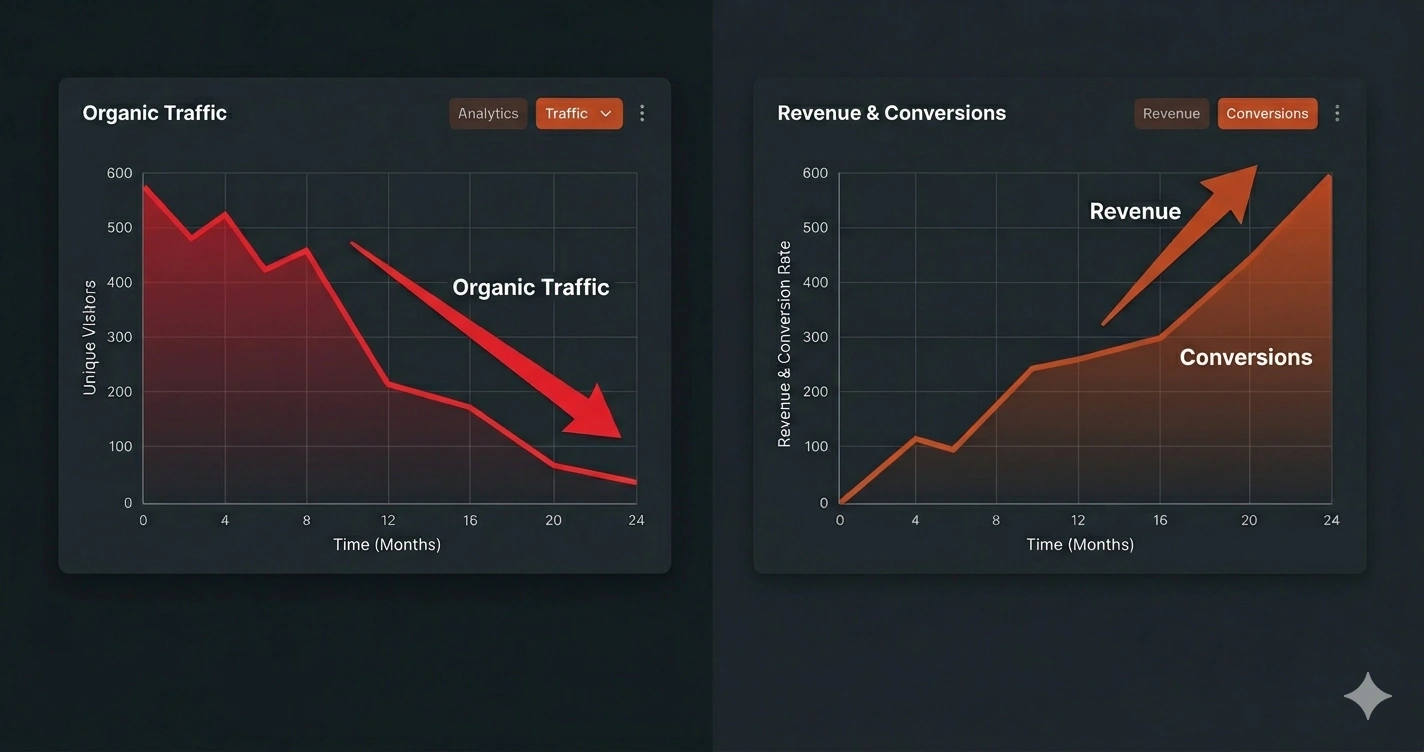
Organic traffic is falling for many brands right now. Revenue and conversions are not following it down. That gap is not a coincidence. It tells you that the way most teams measure digital marketing success has stopped reflecting reality, and fixing that before it shapes the next budget decision matters more than any ranking report.
For years the playbook ran itself. Rankings climbed, traffic followed, you sent a report packed with green arrows, and everyone left the meeting happy. Most digital marketers built their entire routine around that loop. Prove the sessions are growing. Prove the keywords are climbing. Simple, clean, measurable.
That playbook has stopped working. SEO still matters, but the chain between rankings, traffic, and revenue has snapped in the middle. Right now, in 2026, you can hold your best-ever ranking positions and still record your lowest ever click through rates (CTR). You can lose 20 percent of your organic sessions and grow revenue at the same time. Real businesses are experiencing both right now, and if you still lead your reporting with session counts, you are showing leadership an incomplete picture.
Is Website Traffic Actually a Vanity Metric?
Direct Answer: Traffic is not a vanity metric by definition, but most businesses in 2026 treat it like one. When a large share of your sessions carry zero buying intent, and when zero-click search stops high-intent visitors from clicking through at all, raw session volume tells you nothing useful about business performance.
Traffic always served as a proxy for something else. What you actually wanted was revenue, leads, and customers. For a long time, sessions and revenue climbed together closely enough that nobody questioned the connection. You grew sessions, revenue followed. That relationship has now snapped and understanding why it snapped is the first step to fixing how you measure and plan.
Why is Organic Traffic Declining Even When Rankings Hold?
Direct Answer: Three structural changes drive declining organic traffic in 2026. Google’s AI Overviews now answer queries directly before anyone clicks. Zero-click search has taken over informational intent. And buyers now research across ChatGPT, Reddit, and YouTube before they ever open your website.
The first shift sits at the top of the search results page. When someone searches a question, Google now pulls a direct answer from multiple sources and places it above every organic result. Websites that built their traffic on educational, top-of-funnel content have lost a significant share of those visits. The user read the answer. Google served it. No click needed.
The second shift runs broader than AI Overviews alone. Featured snippets, knowledge panels, local packs, and people-also-ask boxes have been eating clicks that used to reach websites for years. AI Overviews have simply accelerated the pace. Showing up inside these formats still builds brand awareness. It just stops adding sessions to your analytics.
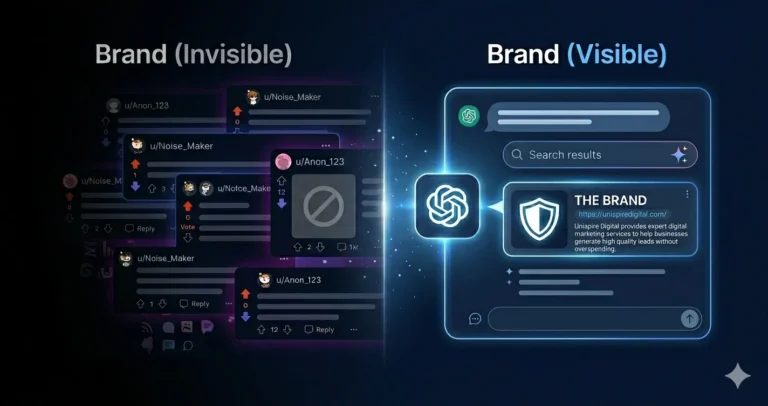
The third shift matters most. Today’s buyers do not open Google first. They open ChatGPT and ask for a shortlist. They check Reddit to read what real users think. They watch two or three YouTube reviews. They scroll a niche forum thread. By the time they land on your website, they have already done the research and nearly made their decision. They arrive to validate and buy, not to learn. We covered exactly how to show up in those AI-driven discovery moments in our guide on how to get your brand mentioned in ChatGPT and AI search.
When your traffic drops but your conversions hold steady, the market sends you a clear message. The visitors who never intended to buy have stopped showing up. The ones with real intent still find you.
What is AEO and Why Does it Matter for Your Content Strategy?
Direct Answer: AEO stands for Answer Engine Optimisation. Practitioners use it to structure content so that AI-powered systems like Google AI Overviews, ChatGPT and Perplexity can understand, trust and cite it as the direct answer to a user’s question. Where traditional SEO chases ranked links, AEO targets the answer slot itself.
The distinction matters because these two goals demand different execution. SEO puts you on a results list. AEO gets AI to select your content as the answer before that list even loads. In 2026, with most searches now resolving inside Google’s own interface, earning the cited-source slot inside an AI Overview often delivers more value than ranking number one below it.
AEO friendly content follows a clear structural pattern. Each section opens with a direct, concise answer to the question that heading raises. Supporting detail follows underneath. That opening structure lets AI systems extract your answer and credit it to your source. Adding FAQ and HowTo schema markup gives search engines a machine-readable version of those same answers. Using specific headings that mirror the exact questions people type or speak to AI tools strengthens the signal further. Our SEO services include full AEO structuring for every piece of content we produce.
AEO and traditional SEO reinforce each other rather than compete. Strong technical SEO, solid backlink authority and fast page performance build the domain trust that makes AI systems willing to cite your content in the first place.
What Metrics Should Replace Traffic as the Primary Measure of SEO Success?
Direct Answer: Drop raw traffic as your primary SEO KPI and track these instead: revenue per organic visitor, conversion rate by traffic segment, assisted conversion attribution, AI citation visibility and engagement quality signals like return visit rate and scroll depth. These numbers reveal buying intent. Session counts do not.
Revenue per organic visitor shows you what each visit actually earns the business. A site with 50,000 monthly sessions converting at 4 percent outperforms a site with 200,000 sessions converting at 0.5 percent. When traffic falls but revenue per visitor climbs, you have not lost ground. You have concentrated your audience around people who actually buy.
Conversion rate broken down by traffic source reveals which channels send buyers versus browsers. Branded search converts far above generic informational queries. That breakdown shows you where your real value lives, and it also pinpoints where a traffic decline genuinely hurts versus where it simply cleans up low-intent visits that never converted anyway.
Assisted conversion data sits in most analytics platforms completely ignored by most teams. A blog post often does not grab the last click before a sale, but a reader may have visited it two weeks earlier during their research phase. That content contributed to revenue even though it did not close the deal directly. Teams that ignore assisted conversions routinely cut their most valuable content by accident. If your pages attract visits but still fail to convert, read our breakdown of why your website is not converting for a direct fix.
AI visibility rounds out the picture. Open ChatGPT, Perplexity, and Google and ask the questions your customers ask. Check whether your brand appears as a cited source. Verify that the facts AI tools state about you are accurate. Dedicated tools for tracking this at scale are still maturing in 2026, but manually auditing your most important queries every month gives you an early signal that no other metric currently captures.
How Does Google’s E-E-A-T Framework Apply to This Shift?
Direct Answer: Google’s EEAT framework rewards content that demonstrates real firsthand knowledge rather than polished summaries. In 2026, Google uses E-E-A-T signals to separate genuinely useful human-authored content from AI-generated filler and those same signals influence which sources AI Overviews choose to cite.
Google added the Experience element specifically to counter the rise of AI-generated content. AI tools can synthesise information from thousands of sources. What they cannot do is draw on genuine firsthand involvement with a topic. A digital agency writing about conversion rate trends from real client campaign data carries a fundamentally different trust signal than a generic article that summarises the same concepts from secondary sources. Google quality raters notice that difference and score it accordingly.
To strengthen your content under E-E-A-T, include real observations from your own work. Cite specific numbers you have seen in practice. Share opinions that came from doing the work, not just reading about it. Add a named author bio with verifiable credentials. These signals tell Google quality raters and AI citation systems that a real expert with relevant experience produced the content.
The strategic implication runs deep. High-volume generic content now damages your authority more than it builds it. Fewer, sharper, more genuinely expert articles consistently outrank a content calendar built purely around keyword volume targets. If you need help producing that kind of content at scale, our content writing services focus entirely on E-E-A-T-led, experience-driven writing.
What Should You Actually Do Differently Starting Now?
Direct Answer: Stop leading reports with total session counts. Track revenue per visitor, conversion rate by segment, and AI citation visibility instead. Structure every new article with direct AEO answer blocks under each heading. Add a credentialled author bio to existing pages. Build presence on the platforms where your buyers research before they ever reach your site.
Start with the reporting conversation because it drives every other decision. When leadership spots a traffic decline, the instinct is to demand more content, more links, more budget. Show them that revenue per organic visitor is climbing, that branded search is growing, that conversion rates on key product pages have improved, and the conversation shifts entirely. You stop defending a decline and start explaining a quality shift that actively benefits the business.
On the content side, pull up your existing pages and find the ones that still attract visits but convert nobody. Either restructure them around bottom-of-funnel intent or consolidate them into fewer, stronger pieces. For every new article you plan, start the brief with the exact question your audience types into ChatGPT or Google, not just a keyword with volume attached to it. Answer that question clearly and directly first. Then build the supporting depth, data, and expertise around it.
On the platform side, your buyers conduct research before they reach your website and that research is not invisible. It happens on specific subreddits, YouTube channels, niche forums, and AI tools. Showing up as a trusted voice in those spaces now sits inside your acquisition funnel whether it ever generates a trackable session or not. The shift toward AI-driven commerce is already reshaping how buyers discover products, which we explored in detail in our article on Google Agentic Commerce tools in 2026.
Frequently Asked Questions
Does declining organic traffic always mean your SEO strategy is failing?
No. Declining traffic often reflects zero-click search and AI Overviews absorbing informational queries that never converted in the first place. When revenue per visitor and conversion rates hold steady or climb, the drop in raw sessions signals audience quality improving, not strategy failing.
What is the difference between SEO and AEO?
SEO gets your pages to rank inside a list of search results. AEO gets AI systems to select your content as the direct answer inside generated summaries, featured snippets, and voice results. Both disciplines share the same technical foundations but AEO adds specific structural requirements around answer formatting and schema markup.
How do you measure visibility in AI Overviews and AI tools?
Open Google, ChatGPT and Perplexity and search for your core queries. Check whether your brand or content appears as a cited source. Dedicated tracking tools for AI citation visibility are still maturing in 2026, but manually testing your most important queries every month gives you a practical starting point that no passive tool currently replaces.
Should you stop creating top-of-funnel informational content?
Not entirely, but the calculus has shifted. Informational content that draws on genuine firsthand experience and delivers specific insight that AI tools cannot synthesise on their own still builds brand authority and earns citations. Generic informational content that simply restates common knowledge no longer justifies the production cost it did two years ago.
The Unispire Digital team helps brands grow through SEO strategy, content marketing, and digital performance. We wrote this article drawing on hands-on experience running organic search programmes across multiple industries and tracking how search behaviour has shifted through 2025 and 2026. Every observation in this piece comes from actual campaign work, not secondary research alone.




One Comment