

Why Your Website Isn’t Converting and What You Can Do About it
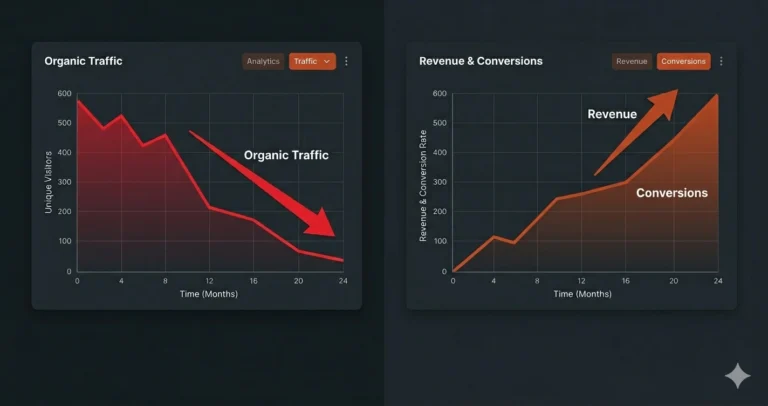
You spend money on ads. You invest in SEO. You put in the hours. Traffic comes in but sales don’t follow. Sound familiar?
Here is the hard truth: most businesses don’t have a traffic problem. They have a clarity problem. And until you fix that, no amount of traffic will save you.
The 10 Second Decision
The moment a visitor lands on your website, their brain makes a snap judgment. People decide whether to stay or leave within 10 seconds. It has nothing to do with your pricing. Nothing to do with your product quality. It comes down to one simple question running through the visitor’s head.
Is this for me?
If your page doesn’t answer that instantly, they are gone. And they are probably not coming back.
Your Website Has an Orientation Problem
Most people think Conversion Rate Optimization is about persuasion. So they add more copy, more pop-ups, more testimonials and more features. They change button colors and run A/B tests.
But none of that works when the real problem is not persuasion. It is positioning.
When someone lands on your page, their brain rapidly fires three questions. What is this? Is it for me? Can I trust it?
If your above-the-fold area, meaning the first screen a visitor sees before scrolling, does not answer all three, they leave. Not because they dislike you. Because they could not orient themselves fast enough.
This is the core issue on hundreds of websites. The product is good. The value is real. But the page was built from the inside out, written for people who already know the business and not for a first time stranger.
Open your homepage right now. Look only at what is visible without scrolling. Can a complete stranger tell what you do, who it is for, and why they should care in a single glance? If not, you have a clarity problem.
Your Best Content Is in the Wrong Place
Here is something most business owners do not realize. The information on your site is probably fine. It is just sitting in the wrong place.
Think about a typical homepage. You land, see a vague headline like “Innovative Solutions for Modern Business,” then a hero image, then a paragraph about company values. Four or five sections later, you finally find an explanation of what the product actually does.
By then, the visitor is already gone.
Most people do not scroll past the second or third content module. If your value proposition lives in the fourth section, the majority of your visitors never see it. That is not a writing problem. That is a structural problem.
The fix is simple but powerful. Audit where your key information sits, then move it up.
Find your clearest benefit statement, that one line that makes someone say yes, this is exactly what I need. Then put it at the top of the page, not buried below the fold.
A tool like Crazy Egg can help here. Install it and turn on heatmaps and scroll tracking. Within a week, you will see exactly where visitors drop off and where your content should live.
The Three Question Framework
Every page on your site needs to answer three questions. Not eventually. Not after scrolling. Immediately.
What is This?
Skip the industry jargon. Write like you are explaining it to a smart friend who knows nothing about your business.
Instead of saying “We deliver conversion focused digital commerce solutions,” say “We help e-commerce brands reduce cart abandonment.” Specificity builds trust. Vagueness creates friction.
Is This for Me?
Generic messaging feels safe because it does not exclude anyone. But messaging that speaks to everyone converts no one.
Your page needs to call out who it is for. Name their situation. Acknowledge their problem. Speak to their goals. When visitors see themselves in your words, they stop skimming and start reading.
Can I Trust This?
Trust signals do not belong at the bottom of the page. They belong right next to the claims that need backing up.
If you say you have helped over 500 businesses, put the client logos right there next to that sentence. If you claim specific results, place a testimonial directly underneath that claim.
Do not make people scroll to find proof. Give it to them while they still care.
Take your three highest traffic pages and score each from 1 to 10 on how clearly the first two modules answer these three questions. Any page below a 7 needs restructuring before you spend another dollar on traffic.
Not All Traffic is the Same
This is where most businesses lose serious revenue without even knowing it.
Imagine three people arriving at your homepage today. The first person searched your brand name on Google. They already know you. They need validation and specific details to confirm their decision.
The second person clicked a Facebook ad. They were interrupted mid-scroll. They have zero context about you and need to be oriented and shown proof before anything else.
The third person came through organic search for a specific problem. They are curious but not committed. They need to feel understood before they will trust you.
Three people. Three completely different mindsets. Three completely different needs.
Sending them all to the same page quietly kills conversions across every channel.
The solution is to align your page to the mindset of the traffic source, not just the product you are selling. You do not need to build 20 pages overnight. Start with your biggest traffic source. If most visitors come from paid ads, build a dedicated landing page for that audience. Match the headline to the ad. Match the tone to the platform. Then measure the difference.
The Moment of Hesitation
You have fixed the clarity. You have matched the intent. Your page is doing everything right. But people still are not converting.
Here is why.
There is a moment that happens on almost every page for almost every visitor. They are reading. They are interested. They are almost ready. And then something stops them. A question they cannot answer, a risk they cannot measure, or a missing detail they were looking for.
This is called peak hesitation. And it is where a sale is won or lost.
Most businesses respond by chasing visitors after they leave through retargeting ads, follow-up emails, and discount codes two weeks later. It works sometimes but by then the moment has already passed.
The smarter move is to prevent hesitation from happening in the first place.
Look at your checkout drop-offs. Look at your form abandonment. Look at the exact page and the exact moment people leave. That is your hesitation point.
Then ask one question. What piece of information is the visitor missing at that moment that would give them the confidence to move forward?
Answer that question on the page at that moment and in that spot. Not in a footer FAQ. Not in a retargeting email three days later. Right there, where the hesitation happens.
The Real Lesson Behind CRO
Most businesses build their pages on a false assumption. They assume visitors already understand what they do, why it matters, and how to make a decision.
They do not.
Every visitor is a stranger encountering your business for the first time. They are distracted. They are skeptical. They are one click away from leaving.
Real CRO forces you to look at your business through the buyer’s eyes and not through your internal narrative or company terminology.
Stop optimizing for the experience you wish visitors had. Start optimizing for the experience they actually have.
Focus on what happens the moment someone lands. Page load speed matters. Navigation paths matter. Whether the value proposition is clear in the first screen matters. Where friction exists matters. What the next step looks like matters.
All of it affects conversion. All of it affects the customer experience.
Final Thought
More traffic will not fix a broken page. It will just send more people to a page that does not work.
Fix the clarity first. Match the intent. Remove the hesitation. Then scale the traffic.
That is the order that actually works.
Need help auditing your website for conversion problems? Unispire Digital specializes in data-driven SEO and digital marketing strategies that turn visitors into customers. Contact us to get started.
FAQs About Website Conversion Rate Optimization
Why is my website getting traffic but no conversions?
Most websites get traffic but fail to convert because visitors cannot quickly understand what the business offers and who it is for. When a page lacks clarity in the first screen, visitors leave within seconds without taking any action.
What is above-the-fold content and why does it matter?
Above-the-fold content is everything visible on a webpage before a visitor scrolls down. It matters because most visitors decide within 10 seconds whether to stay or leave. If your value proposition is not clear in that first screen, you lose the visitor before they see the rest of your page.
What are the three questions every webpage must answer?
Every page must immediately answer three questions. What is this? Is this for me? Can I trust this? If your page fails to answer all three within the first two sections, your conversion rate will suffer regardless of how good your product or service is.
What is intent matching in CRO?
Intent matching means aligning your page content to the mindset of the traffic source. A visitor coming from a Google search has a different mindset than someone who clicked a Facebook ad. Sending both to the same generic page costs you conversions from every channel.
What is peak hesitation and how do you fix it?
Peak hesitation is the moment a visitor is almost ready to convert but stops because of an unanswered question or an unclear detail. You fix it by identifying exactly where visitors drop off on your page and placing the missing information right there, not in a footer or a follow-up email.
How long does it take to improve website conversion rates?
Some improvements like moving your value proposition above the fold or adding trust signals next to your claims can show results within days. Deeper structural changes backed by heatmap data typically show measurable improvement within 30 to 60 days.
What tools can help improve website conversions?
Crazy Egg is one of the most useful tools for CRO. It shows heatmaps and scroll tracking data so you can see exactly where visitors drop off and where your best content should be placed. Google Analytics and Microsoft Clarity are also helpful for understanding user behavior.




2 Comments